The Human Limits of Technological Progress
Why the technologies that make life easier may also make meaning harder to find

As large language models and generative AI continue to evolve at an incredible pace, I find myself thinking more and more about the impact they may have on our society.
Technological Progress
To explore that question, I think it makes sense to first step back and look at technology itself, what it represents and what role it has historically played in our lives.
I was born in the 1990s, and when I think about technology, two core ideas immediately come to mind:
Innovation
Convenience
Whether it was the transition from film cameras to digital photography, from vinyl records to iPods and MP3 files, or today’s shift from internal combustion engines to electric vehicles, technological change has always been accompanied by innovation.
New discoveries, new capabilities, and new ways of doing things have continuously pushed the boundaries of what is possible.
These advances eventually materialize into products and services designed to offer something better, more efficient, or more accessible. In many cases, they save us time, reduce effort, and lower costs.
For the end user, this is usually a very attractive trade-off. Tasks that once required more time, skill, or resources can now be completed more easily, often with better tools and potentially better outcomes.
I use the word potentially on purpose, because quality itself is often subjective. Does quality mean good impression? Or does it simply refer to technical specifications and measurable performance?
After all, a stunning photograph could be taken with an analog camera in the 1970s. Today’s photos may offer higher resolution, more detail, and the ability to be instantly shared, edited, and stored digitally. From a technical standpoint, they are undoubtedly superior. But that does not necessarily mean they are more beautiful.
The Cycle
We invest capital into research and development, we create new technologies, those technologies become products and services, they are sold to consumers, profits are generated and reinvested.
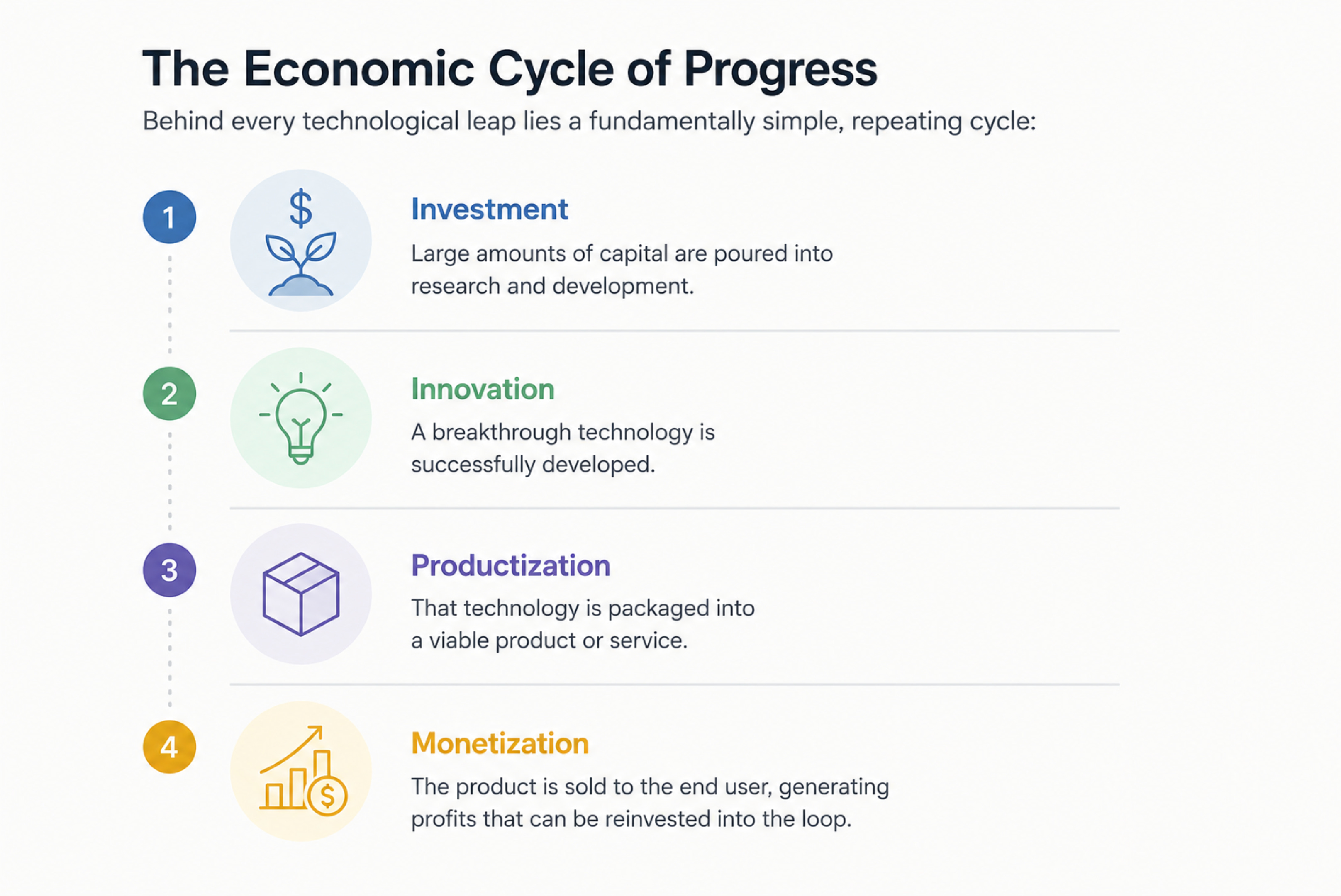
At its core, that is the cycle of technological progress.
I find this process fascinating. I have tremendous respect for technological innovation and for all the people behind it, the human mind is remarkable. As our collective knowledge expands, so does our ability to improve the world around us and advance as a society.
Without technological progress, it is difficult to imagine fields such as medicine evolving at the pace they have. Countless lives have been improved and saved through scientific discovery and innovation.
For that reason, I believe technology is fundamentally a force for good.
Yet lately, as the pace of change continues to accelerate, I find myself asking a different question. Are there secondary effects that accompany technological progress? Consequences that are not immediately visible, but gradually emerge as innovation reshapes the way we live, work, and think?
Disclaimer: I cannot guarantee the accuracy or timeliness of the information provided herein. This article does not constitute financial advice, an investment recommendation, or a factual basis for your investment decisions. Please conduct your own due diligence.
Humanity
We’ll return to technology in a moment.
Before we do, I’d like to briefly step into the territory of anthropology, psychology, and perhaps even philosophy.
When I think about what contributes to a meaningful human life, a few recurring themes come to my mind:
1. Community
Human beings have always lived in groups. We are social creatures by nature, even if the degree varies from person to person.
As an introvert, I genuinely enjoy solitude. Yet some of the most fulfilling moments in my life have come from meaningful conversations and deep connections with other people. There is something uniquely human about being understood by another mind.
2. Learning and Growth
Growth begins with curiosity.
When we have the time and space to think, study, and explore, we deepen our understanding of the world and of ourselves. Whether through research, science, education, or simple reflection, the pursuit of knowledge has always been one of humanity’s defining characteristics.
It is through learning that we continue to evolve.
3. Work and Purpose
Of course, some people view work primarily as a necessity.
But at its best, work offers more than income. It teaches discipline, develops competence, and allows us to contribute to something larger than ourselves. Meaningful work gives direction to our efforts and helps us feel that our time is being invested rather than merely spent.
4. Creativity and Ideas
Creativity emerges at the intersection of knowledge, effort, and enthusiasm.
It is the ability to imagine something that does not yet exist. To connect ideas that seem unrelated and transform them into something new.
In many ways, creativity is the foundation of innovation itself. Every invention, business, artwork, and technological breakthrough began as an idea in someone’s mind.
5. Rest and Reflection
Finally, after all of this, we need rest.
We are not machines. We have physical limits, emotional limits, and cognitive limits. Periods of stillness allow us to recover, reflect, and regain the energy needed to continue moving forward.
Rest is not the opposite of productivity. It is one of its prerequisites.
As I write this, I cannot help but notice how closely it mirrors the opening pages of the biblical Genesis. All of these foundational elements are laid out right there: the creation of time, space, and matter; the shaping of the earth; the design of mankind for connection and purpose; and, ultimately, the intentional act of rest.
Perhaps that is not a coincidence.
Suffering for Growth
As a believer, one question I am often asked is this:
If God loves us, why does He allow suffering?
There is no simple answer to that question. But I think it is worth considering the alternative. What would life look like if there were no pain, no obstacles, no frustration, and no struggle? What if everything were always easy and always worked out exactly as we wanted?
Personally, I don’t think I would want to live in such a world. Whenever I go through something difficult, when I fail, when I face resistance, when something hurts, it is rarely pleasant in the moment. Yet those experiences often become the very things that shape me the most. Challenges force us to grow. They reveal weaknesses we didn't know we had. They teach resilience, patience, humility, and perseverance.
In many ways, hardship is what transforms experience into wisdom. Struggle also has a remarkable ability to bring people closer together. When we lean on family, friends, or a partner during difficult times, relationships deepen. It often reveals who we truly are and what we truly value.

No Shortcuts up the Hill
I’ve recently been spending a lot of time cycling, and if I’m being honest, I hate climbing hills. The climb is slow, my legs burn, my back hurts. Every instinct tells me to stop. But when I finally reach the top, I know I earned it.
The view from there is rewarding precisely because of the effort it required to get there. That seems to be part of the design.
Now imagine a teenager passing me halfway up the hill on an electric scooter. He reaches the same destination, he enjoys the same view, he receives the same reward. But he arrives there without the effort. And this is where my thoughts begin to return to technology.
Technology has always aimed to reduce friction, remove obstacles, and make life easier. The question I find myself asking is, what happens when we start removing not only unnecessary hardship, but also the very challenges that help us grow?
Social Distance
As I’ve already mentioned, I view technology as fundamentally positive.
At the same time, I also believe there are certain aspects of human nature that deserve protection. And some technologies, despite their many benefits, may unintentionally weaken those aspects. Social media is one example.
It has made communication easier than at any other point in human history. We can stay connected across continents, instantly share experiences, and maintain relationships that would have otherwise faded away.
Yet there is a growing question of whether digital connection always translates into genuine human connection.
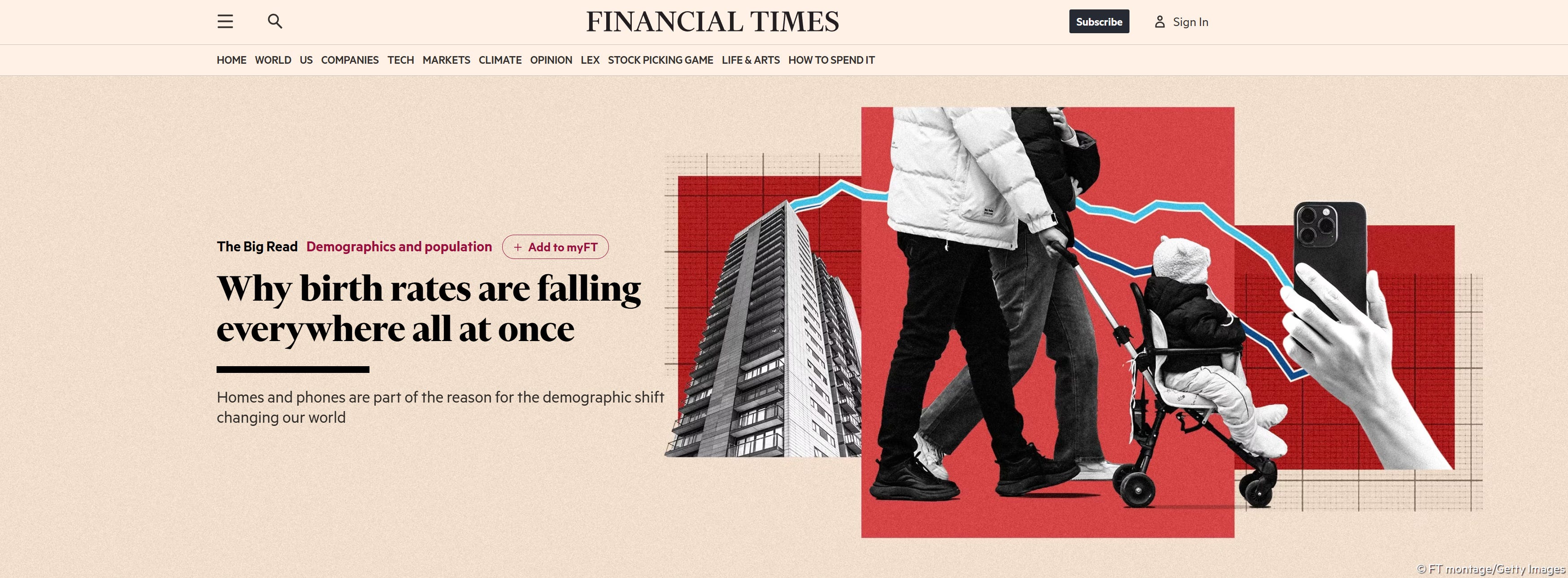
I recently came across a fascinating article on FT.com that explored the relationship between social media, smartphone adoption, and declining birth rates. One of its most provocative observations was that the sharp decline in fertility rates across many countries over the past decade closely coincided with the rise of smartphones and social platforms.
Researchers tracking the rollout of 4G networks across the US and the UK discovered that regions gaining high-speed mobile internet earlier saw a faster drop in fertility rates, particularly among young adults. This identical pattern emerged in dozens of countries, spanning from France and Mexico to Nigeria.
Of course, correlation does not necessarily imply causation. But the hypothesis is intriguing, and it makes perfect sense. When we scroll through our feeds, our brains are tricked into a false sense of companionship. The dopamine system rewards us with instant gratification, we feel connected, we feel entertained, we feel stimulated.
But it is just an illusion, a short-term biological hack that temporarily numbs what we are actually lacking on a physical, emotional level.
When Everything Becomes Easy
The rise of large language models and generative AI introduces a similar question.
For the first time in history, millions of people can generate images, videos, music, software, writing, and entire businesses with only a few prompts. The barriers to creation have fallen dramatically. It requires no capital, almost no skill, minimal attention, and zero emotional investment. Everyone can do everything, effortlessly.

I am not suggesting this is inherently wrong. However, it represents a highly dangerous experiment on human nature and our psychological needs. If everything becomes frictionless, we eliminate all natural resistance from our personal and professional journeys.
If we no longer have obstacles to overcome or hard skills to master, we risk losing the very meaning behind our endeavors. When the struggle is removed, the unique distinctions that define us vanish as well.
When there are no mountains left to climb, society quickly grows complacent. What will this soft and lazy approach do to our capacity for genuine joy, our sense of purpose, our creativity, our mental health, and the fabric of civilization itself?
Why This Matters
We are currently standing at what might very well be the absolute peak of AI euphoria. Tech stocks are trading at all-time highs, and market expectations are unprecedented. My reason for reflecting on this deeper context is because I want to understand what this seismic shift means for us.
Beyond the immediate tech hype, which sectors outside of AI will become vital in the coming months and years? What is about to change, and where will the demand shift?
Wellness and Mental Health
One area that increasingly captures my attention is wellness.
Studies show that between 2010 and 2021, the rate of clinical depression among American teens surged by a staggering 150%. In the US and the UK, hospital admissions for self-harm among young girls spiked by 188% year-over-year after 2012.
Professor Jonathan Haidt and his team, in an extensive, ongoing scientific synthesis updated for the World Happiness Report, demonstrated that this collapse in mental health did not happen in a vacuum. It occurred synchronously across the Western world at the exact moment global youth transitioned from a traditional, play-based childhood to a phone-based childhood.
While alarming, from an investment standpoint, this structural shift signals that the wellness economy, focusing on both physical and mental health is going to grow. Over the past decade, we have already witnessed a massive surge in demand for offline experiences that promote stillness, like meditation, yoga, biohacking, saunas, and recreational sports.

It is a logical psychological defense mechanism. The more deeply immersive and overwhelming our technology becomes, the more desperately we seek a temporary escape, a sanctuary for both body and mind.
The underlying motivations for fitness have fundamentally shifted too. Fifteen years ago, people picked up running or hit the gym primarily for weight loss or aesthetics. Today, the drivers are psychological. According to the 2026 Global Fitness Report by Les Mills, the motivation to exercise for mental well-being and emotional resilience has jumped by 29% since 2021. Similarly, exercising primarily to combat stress has risen by 17%.
None of us can accurately predict the ultimate ceiling of artificial intelligence or how deeply it will reshape global markets. What we can predict with a high degree of confidence, however, is that this relentless evolution will have a direct impact on the core of human nature.
As the world becomes increasingly automated and digital, investing in industries that help us preserve, restore, and protect our fundamental humanity will become more critical and lucrative, than ever before.
When Intelligence Is No Longer Unique
Generative AI is directly targeting the most unique faculties of human intelligence, our creativity, our logical reasoning, and ultimately, the very meaning of our existence.
In the coming years, we may face a profound psychological battle against the urge to constantly measure ourselves against this new technology.
We may be forced to rediscover purpose in things that belong solely to us; tasks stripped of technological shortcuts. This is precisely why, from an investment and societal standpoint, I am betting on a massive return to core human values, to physical wellness, and to nature.
We might see a surge in people escaping to national parks, retreating into the wilderness, and seeking offline sanctuaries far away from civilization and digital noise. Our mental and physical health would practically demand it. In a world moving this fast, the alternative is simply burning out.
Just as we are currently witnessing the romantic revival of vinyl records, analogue cameras, and vintage fashion, I am convinced that a new cultural shift is on the horizon. One day soon, the ultimate status symbol and the coolest thing you can do will be something like turning your phone completely off.
Next time, I might talk about stocks again, we’ll see.
Have a great day!
11.6.2026 ~ The Value Philosopher
If you enjoyed this article and want to read more about the intersection of macroeconomics, technology, and investing, consider subscribing.
Disclaimer: I cannot guarantee the accuracy or timeliness of the information provided herein. This article does not constitute financial advice, an investment recommendation, or a factual basis for your investment decisions. Please conduct your own due diligence.